
The Community 120 Years Ago: Transforming Prefectural Ties into Pan-Japanese American Solidarity
An Analysis of Early Issei Settlement from the 新世界 (Shin Sekai) • September 2, 1906
The September 2, 1906, edition on pages 3-4 of the 新世界 (Shin Sekai), details the daily labor, wages, and social practices of the Issei.
The article entitled Dispatches from Los Angeles [ローサンセルス通信”] provides a direct look into the economic reality of Japanese workers in Southern California. The article indicates that the summer fever among Issei in LA, caused many of them to fall ill daily. Due to the high demand for agricultural and physical labor, Issei workers faced a heightened vulnerability to heat exhaustion and sickness in addition to the poor sanitary conditions they suffered. Issei manual laborers earned a daily wage of “$1.35” per day, today’s equivalent to about $50.09 a day in 2026.
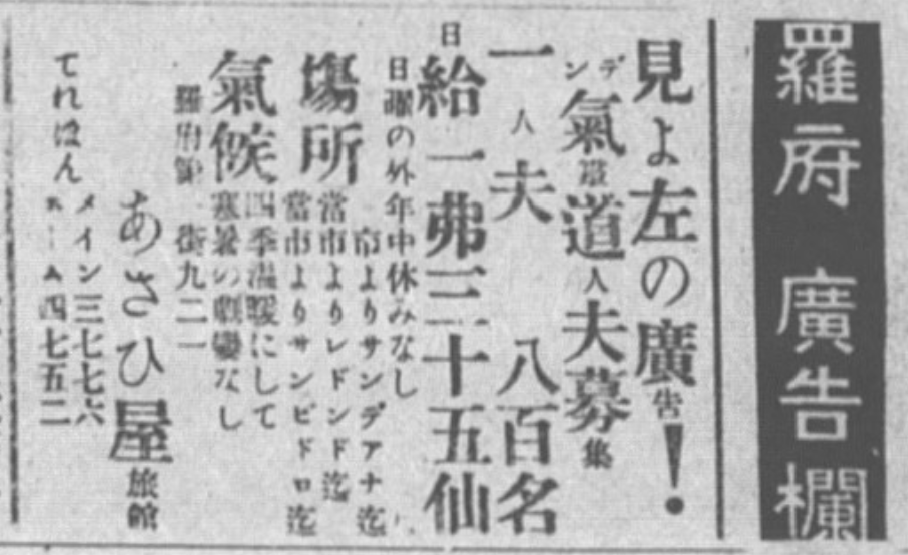
In addition to the wage figures, the article describes how laborers managed daily routines during the summer heat, arranged temporary room and board, and navigated employment opportunities across agricultural and municipal work sites. The article also included tips on how to avoid falling ill and taking care of oneself.
In addition to describing the condition of workers, the article also serves as a survival directory for immigrant workers. Shin Sekai also allowed for ads by Labor recruitment agencies to place job services listed under headings like “勞働口周旋” (Labor Placement Agencies) in addition to featuring advertisements for Japanese run boarding houses and hotels like the Toyo Hotel, Fukui Inn as well as listings of neighborhood support. Outside of prefectural associations (kenjinkai) that supported Japanese immigrants adjusting to new life in the states, institutions like the Shin Sekai and Yokohama Specie Bank often added support to the guidance of new incoming Japanese immigrants.
As more newcomers arrived, the mutually supportive network made economic partnerships stronger between businesses and new Issei outside of prefectural circles, creating a self-reliant economic community, as well as help to those who did not have deep prefectural ties. Newspapers like Shin Sekai had a statewide circulation and helped spread information throughout the whole community, allowing a larger circle of Issei to identity as an ethnic group rather than just by prefectural ties.
Another article in this edition encourages readers to put aside private animosities and regionalism to build a social trust that can extend throughout the entire community “交際的關係の利害” (The Advantages and Disadvantage of Social Intercourse). This was emphasized by noting a story of a legal battle that illustrated harm to the collective reputation and financial standing of Japanese immigrants in America.
While Kenjinkais remained a valued social club/group, the daily struggle and necessity to find work, housing, and services, as well as interminority tensions, moved isolated prefectural groups and intra-ethnic rivalry into the more unified “pan-Japanese American” Nikkei identifying community that we see today.
Sources & Primary Documents
新世界 (Shin Sekai / Japanese Daily New World), September 2, 1906, Issue No. 3962
Page 3: Dispatches from Los Angeles [ローサンセルス通信] tnw_19060902_0003.pdf
Page 4, Column 1: Labor Placement Agencies, Toyo Hotel, Fukui Inn
tnw_19060902_0004.pdf
Page 1: The Yokohama Specie Bank, Ltd., San Francisco Branch
tnw_19060902_0001.pdf
Page 3: The Advantages and Disadvantages of Social Intercourse [交際的関係の利害] tnw_19060902_0003.pdf