Following the 1907 Gentlemen’s Agreement which barred further entry of Japanese men to the United States, thousands of young Japanese women crossed the Pacific to the United States as “picture brides” [This term later became a demeaning way to label Issei women]. These women immigrated to this country to marry Japanese men through a pre-arranged marriage. Many women only had a photograph or letter to rely on before meeting their husbands upon their arrival into this country. For many, the journey was a shocking introduction. The reality of their new lives clashed harshly with the promises they had been given; they found themselves in a strange, segregated country, wed to strangers that looked nothing like the pictures sent, and completely unprepared for the emotional and economic hardships of the quality of life they now faced.
To help these vulnerable women navigate their difficult new reality, a visionary group of Issei (first-generation) women, including Yona Abiko, a prominent member of the Japanese American society at that time, founded the San Francisco Joshi Seinen Kai (Young Women’s Association) in 1912. This association later became the Japanese YWCA as Japanese women were strictly barred from using the whites-only facilities including the San Francisco YWCA. Thus, they had no choice but to build their own independent sanctuary which was designed by architect Julia Morgan.
The organization, (and later building), served as a vital lifeline for these women. It offered emergency and temporary housing for new arrivals, some who were abandoned shortly after their arrival, and provided essential skills such as learning English, understanding American customs, cooking, and sewing. Beyond survival, the Joshi Seinen Kai focused deeply on uplifting the inner lives, emotional well-being, and moral character of its members. This can be shown in many Shin Sekai articles published by Joshi Seinen Kai from America and Japan. Navigating an unexpected and often disappointing reality in a hostile country took a massive psychological toll. The association offered a vital space for women to process their feelings, work through their isolation, and lean on other supportive women.
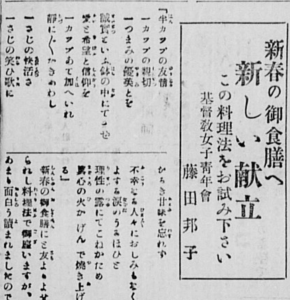 “A New Year’s Recipe”
This focus on inner strength and character is captured in this Shin Sekai newspaper clipping featuring a metaphorical “New Year’s Recipe” submitted by club member Kuniko Fujita.
Roughly translated in English, “To the New Year’s Dining Table: A New Recipe,” the article bypasses actual food to offer a poetic guide for living a virtuous, resilient life.
-
Blend “half a cup of friendship” and “one cup of kindness.”
-
Add a pinch of grace, and put these together inside a “bowl called sincerity.”
-
Add one cup each of “love, hope, and faith,” and stir quietly.
-
Add a spoonful of cheerfulness and smiles, give generously to unfortunate people with sympathetic tears, knead the mixture with the dew of reason, and finally, bake it over the “heat of a sincere heart.”
The mission to guide and support women through changing times was not limited to the United States. There were other branches in Japan, such as the Osaka Joshi Seinen Kai, which was established to help young women navigate their evolving roles in a modernizing world.
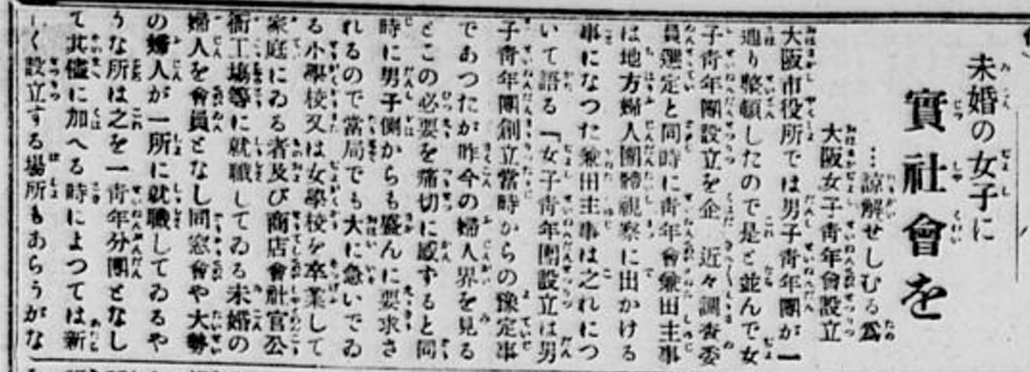
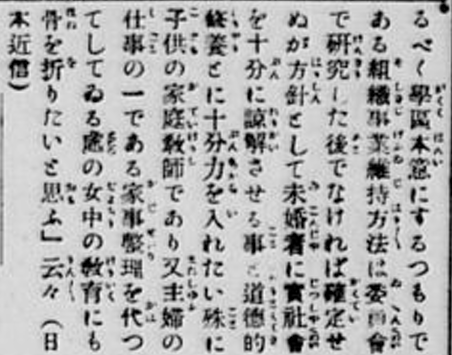
In another Shin Sekai newspaper clipping, the headline roughly translates to: “To help unmarried women understand real society / Osaka Women’s Youth Association Established.”
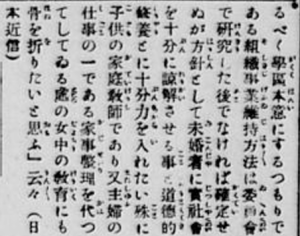
The article explains that after the successful organization of a men’s youth group by the Osaka City Hall, strong demand necessitated a parallel women’s group.
This branch aimed to recruit unmarried women who had graduated from elementary or girls’ schools, including those working in shops, companies, factories, and government offices. Their central goal was to provide “moral cultivation” and help these women “fully understand real society.” The article also explicitly translates a desire to focus on the “education of maids,” noting that maids effectively acted as family tutors for children and took over the heavy responsibilities of household management.
Whether in San Francisco or Osaka, the Joshi Seinen Kai was much more than a social club. It was a critical emotional and cultural refuge that empowered women to endure the profound shocks of their changing lives.