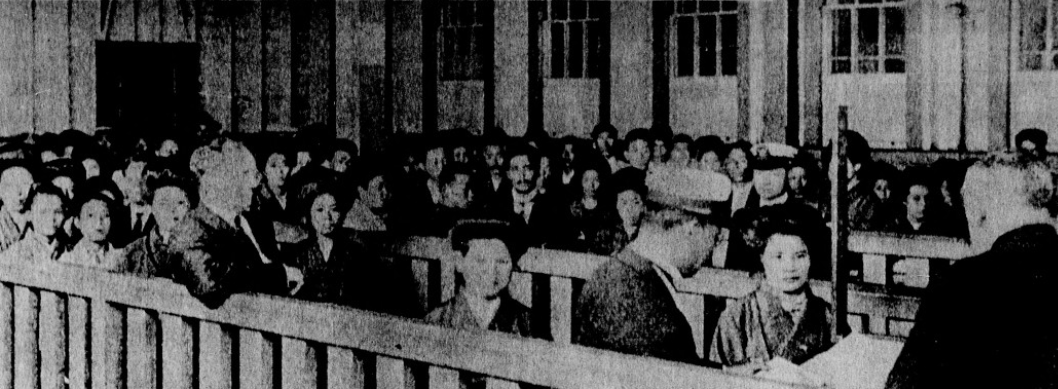
The Community 120 Years Ago: Issei Women
Official and unofficial records illustrate that the first group of Japanese women arrived in the United States between 1908–1920. They were often referred to as “picture brides,” but this generalized term does not accurately reflect what this first generation of women endured.
Through examining articles from the Hawaii Hochi, Shin Sekai, and oral histories housed at JAHA, we are able to get a better understanding and respect for what these women were forced to, in many cases, tragically experience from the moment they boarded the ship bound for the United States. It was not an uncommon practice in Japanese culture for a family to ask a friend or family member to introduce their son or daughter to a prospective marriage partner, and there are still instances where this happens today. This tradition is often referred to as miai.
However, for Japanese men residing in the United States in the early 20th century, it was not easy for a formal prospective marriage arrangement to take place because of the cost and distance between the two countries, and thus a substituted system of relying exclusively on a photo was adopted to start a relationship. Thus, the euphemism “picture bride” evolved. This label also characterizes early immigrant Issei women by a single moment and a photograph, suggesting that they were passive participants in their own lives. Some women came to the US to make their families happy; some chose to emigrate for their own reasons based on potential economic opportunity or family circumstances; and some arrived with the hope of a new beginning. Once here, they worked on farms, ran businesses and households, raised the Nisei generation, and helped build the Japanese American community.
In short, they were not “only brides”: they were Issei women whose lives extended far beyond the day they stepped off the ship. Thus, JAHA prefers the language use of “photo marriage” or simply “Issei women.”
From the Newspaper Archives
Shin Sekai: “Refusal of Landing for Photo-Married Women Is a False Rumor”
Rough translation
This article reports that the US Secretary of Commerce and Labor instructed immigration authorities to reject Japanese wives entering through photo marriages on the grounds that they were likely to become “public charges.” The report alleges that as many as 90 percent of arriving Asian women faced deportation. After the newspaper made a direct inquiry with the Immigration Bureau, the officials dismissed these claims as groundless. They confirmed that no such directive existed, and that any individual deportations had been carried out under general immigration laws that applied to all nationalities, not because the women were Japanese.
Immigration authorities further clarified that Japanese men and women were admitted on the same terms as nationals of most-favored nations, and that no special legal restrictions or additional burdens applied to photo marriages. The paper emphasized that exaggerated claims of targeted mistreatment had caused unnecessary alarm.
Accompanying commentary defended photo marriages as legitimate legal unions. It condemned malicious falsehoods directed at Japanese women, called for fair and equal treatment free from racial prejudice, and urged the Japanese immigrant community to remain united and composed.
However, anti-Japanese politicians and newspapers of the era used this opportunity to portray the practice of marrying individuals through a photograph as immoral or as a way around immigration limits, and that pressure led Japan to stop issuing passports to photo-marriage brides in 1920.
From the Oral History Collection
JAHA Oral History Reveals Personal Story of an Issei Mother’s Experience
A firsthand oral history reveals the serious personal dangers many Issei women faced upon arrival.
Upon docking in San Francisco, many Issei women did not know where to go or what their husbands actually looked like. In instances where husbands arrived late to the pier, or never came at all, stranded or unaccompanied women were often targeted by men who seemed kind and trustworthy. Promising to find their missing husbands or take them to where their husbands lived, these men lured vulnerable women into prostitution and trafficking. A woman’s life could change in an instant: some were forced into prostitution, while others were saved by people working near the docks who warned them not to go with these men. It was an early lesson that in this new country, they could not trust just anyone.
Here is an excerpt from the oral history in the JAHA files:
“I think my mother came in 1898, she was, I think, 15 years old. My father knew her. They lived about 4–5 miles apart in Usu. – She came third class. She was accompanied as far as Yokohama by my uncle. Once she got on board, she was on her own. There was a nice man that befriended her. She had cleared the immigration, and she had her papers, and my father was supposed to meet her, but he wasn’t there, and the young man told her he’d take her home and take her to her husband. She heard a voice behind her speaking in Japanese telling her to wait until her husband comes. And it was an immigration man. He knew the man by reputation, and he was taking girls into prostitution. She took the advice. —”
— AGR_PER_19881027_0001, JAHA Collection, Interview Transcript