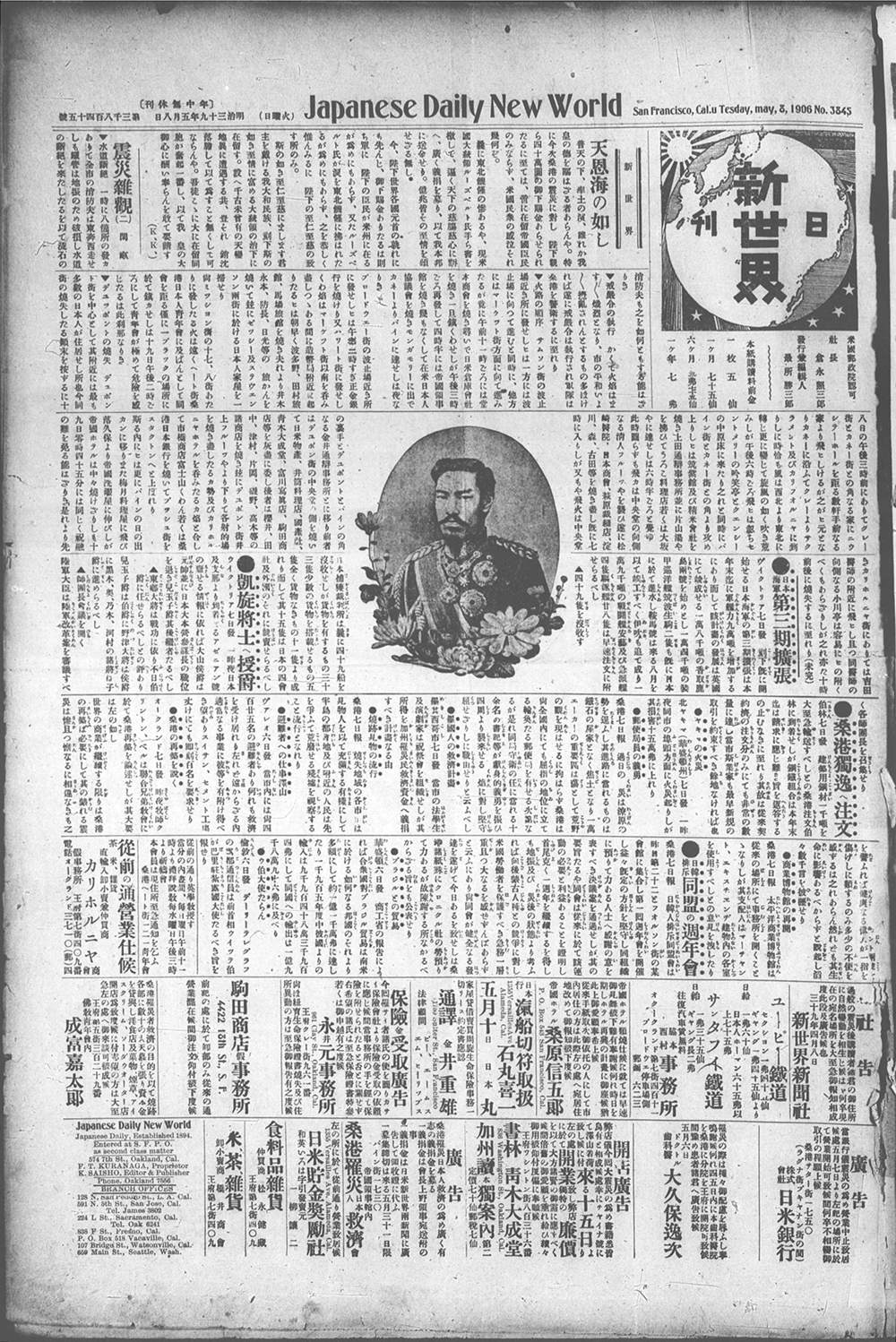
The Community 120 Years Ago: From SOMA to the Western Addition
The 1906 earthquake and fires devastated the Japanese community in South of Market (SOMA), forcing displacement amid intense racial discrimination. Yet from this destruction came renewal. Japanese residents resettled in the Western Addition, laying the foundation for the Japantown that has endured for 120 years.
Japanese newspapers were vital lifelines for the community. Publications like Shin Sekai and Hokubei Mainichi documented community life when leaders and politicians ignored non-white communities. Though many issues of these publications were lost to the fires, during this time the surviving editions are our only link to early Japanese immigrant life before our current SF Japantown.

Here, we see Shin Sekai’s May 1906 issue listing an Oakland address, illustrating the quick reestablishment of the press despite devastation. The Japanese community was largely excluded from official city records and English-language coverage.
A temporary “San Francisco Japanese Relief Office” and business locations were listed in this May 1906 issue to help residents manage finances during the crisis. Coverage extended to the urgent needs of the community, focusing on food supplies and shelter arrangements following the destruction of residential areas. The paper also directed readers to the “Temporary Office of the Japanese Association” located in Oakland to assist those displaced. An image of Emperor Meiji was used as a symbol of unity and stability for Japanese immigrants.
Credits:
- Japanese American History Archives – Seizo Oka Collection. The Shin Sekai (May 1906-April 1912).
- 大震災雑観. “新世界 – The New World.” (San Francisco, CA), May 8, 1906. Accessed January 29, 2026.URL: https://hojishinbun.hoover.org/en/newspapers/tnw
- Hoji Shinbun, Hoover Institution, Stanford University.