The Community 120 Years Ago: Assimilation and Exoticism in the Japanese Culture Fad (1897)
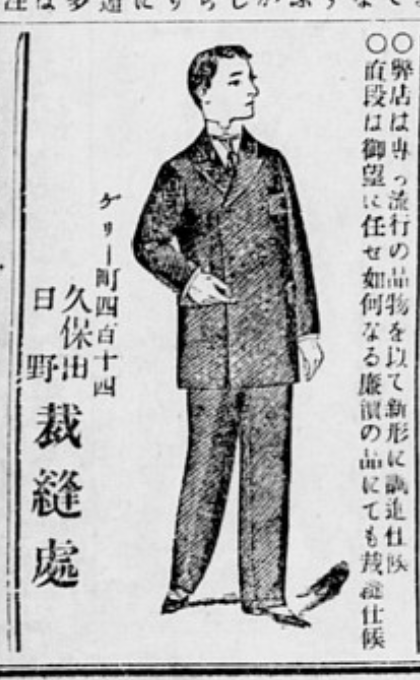
February 10, 1897. Ads from the Shin Sekai (The New World) reveal that Japanese immigrants were actively seeking Western clothing and abandoning traditional Japanese dress.
(Left): Advertisements for businesses such as Kubota Tailoring Place (久保田裁縫處) and Numata Tailoring Place (沼田裁縫處) emphasized the production of Western-style garments tailored specifically for Japanese customers, whose proportions differed from Euro-American counterparts. This advertisement for Kubota prominently features a Japanese man dressed in a formal Western suit.¹
For Issei immigrants, especially women, Western clothing was a social necessity tied to survival and acceptance. Picture brides arriving in the United States between 1907 and 1908 were commonly photographed in kimono upon arrival and then quickly taken to Western clothing shops for fittings. Many wedding portraits show Issei women in Western bridal gowns rather than traditional Japanese wedding attire. Oral histories frequently describe the emotional disorientation of abandoning familiar clothing traditions in favor of American fashion standards.²
As Issei women struggled to adapt to Western dress, white American society simultaneously romanticized and commodified Japanese clothing and femininity. The society that pressured Japanese immigrants to abandon visible markers of Japanese identity indulged in “Japanese luncheon” parties where upper San Franciscan white women dressed themselves in kimono, sandals, and haori as exotic entertainment. Japanese culture was considered fashionable and amusing when performed by white Americans, but undesirable or foreign when embodied by Japanese.³
Issei women often wore Western clothing that was already outdated by contemporary American standards—wearing Victorian-style dresses long after blazers and neckties had become fashionable. This reflects the conservative image of American dress that many immigrants observed before emigrating and how Japanese traditions remained deeply rooted among many immigrants, who chose more conservative and less flashy styles of dress. While white Americans freely experimented with “Japanese costume” for leisure, Japanese women themselves were navigating intense scrutiny over how “American” they appeared.⁴
The San Francisco Call described the trend enthusiastically:
“Japanese luncheons became intensely popular among society women weary of the monotony of English-style afternoon teas and matinee lunches.”⁵
At these gatherings, affluent white San Franciscans decorated themselves and their homes with “Oriental” objects, regardless of origin. Guests consumed dishes labeled “suimono,” “yakizakana,” and “sashimi” while surrounded by imported objects from Turkey, China, and Japan indiscriminately grouped together as “Eastern.” Parties even advertised the presence of servants “only from Japan” as part of the entertainment value.⁶
White women could temporarily wear kimono and imitate Japanese femininity without experiencing the discrimination faced by Japanese immigrants themselves. Meanwhile, Issei women were expected to abandon their own cultural appearance in order to appear civilized and assimilated within American society.
More than 120 years later, Japantown remains associated with Japanese pop culture, fashion, and entertainment. But unlike today’s celebration of Japanese aesthetics, the “Japanese fad” of the 1890s reflected a society fascinated with consuming Japanese culture while marginalizing Japanese immigrants themselves.
Footnotes
- Shin Sekai (The New World), February 10, 1897, advertisements for Kubota Tailoring Place (久保田裁縫處) and Numata Tailoring Place (沼田裁縫處).
- Amy Sueyoshi, “Mindful Masquerades: Que(e)Rying Japanese Immigrant Dress in Turn-of-the-Century San Francisco,” Frontiers: A Journal of Women Studies 26, no. 3 (2005): 67–100.
- Sueyoshi, “Mindful Masquerades,” 67–100.
- Sueyoshi, “Mindful Masquerades,” esp. discussion of Issei women’s adoption of conservative Western dress and immigrant clothing practices.
- “The Japanese Luncheon Fad,” San Francisco Call, February 14, 1897.
- San Francisco Call, February 14, 1897, “The Japanese Luncheon Fad”; see also Sueyoshi, “Mindful Masquerades,” for analysis of the social and racial meanings of these performances.
Bibliography
San Francisco Call. “The Japanese Luncheon Fad.” February 14, 1897.
Shin Sekai (The New World). February 10, 1897. Advertisements. Japanese American History Archives, Seizo Oka Collection.
Sueyoshi, Amy. “Mindful Masquerades: Que(e)Rying Japanese Immigrant Dress in Turn-of-the-Century San Francisco.” Frontiers: A Journal of Women Studies 26, no. 3 (2005): 67–100. http://www.jstor.org/stable/4137374.