
The Community 120 Years Ago: A Comparative Analysis of 1918 Departure Permits, Travel Restrictions, and 20-21st Century Modern Biometrics

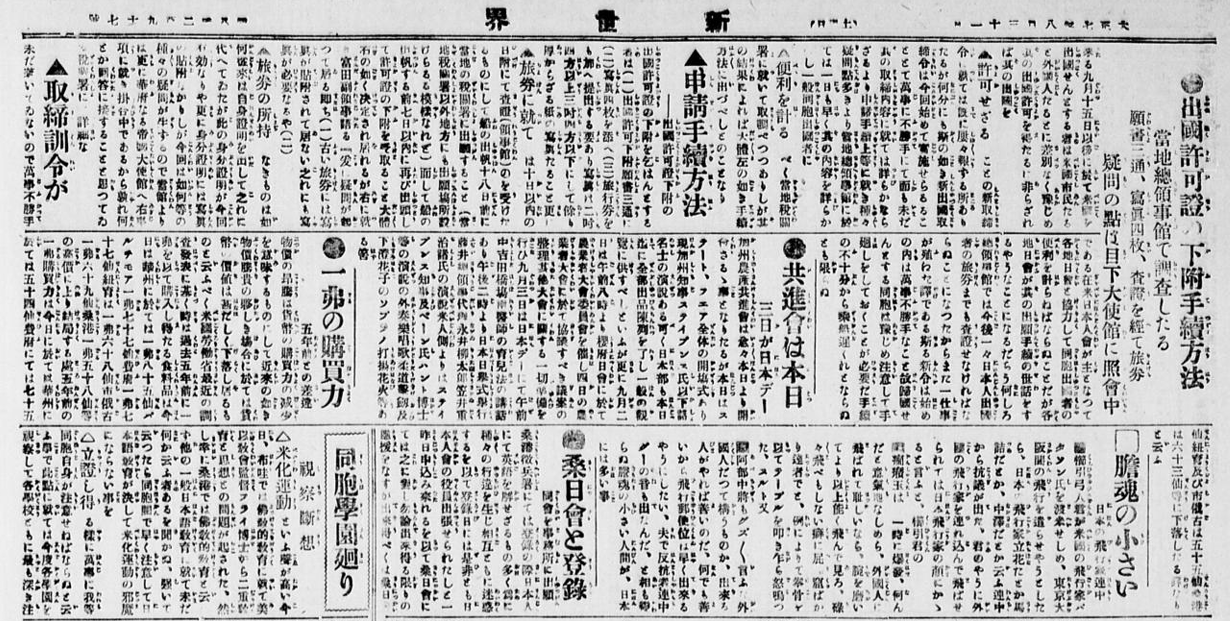
From the Shin Sekai in August 1918.08.31. Page 2.
As World War I neared its climax, the United States Government enacted strict wartime emergency measures designed to monitor and control all individuals departing from its shores. Among these regulations was a mandate requiring all travelers, including Japanese immigrants preparing to return to Japan, to obtain an official Departure Permit (Shukkoku Kyoka) before they would be allowed to board any departing vessel.
Because this federal order was rolled out rapidly under wartime pressure, points of embarkation and foreign consulates were left with little guidance.
To initiate the process, travelers had to compile and submit three identical copies of their departure application alongside their official passport.
Identification was entirely physical. Applicants were required to provide four physical photographs, which had to be precisely sized under four inches square. Most importantly, the protocol required one photo to be physically glued directly onto the passport, while the remaining three photos had to be pasted onto separate sheets of plain, unadorned paper.
Before submitting the application package to U.S. authorities, the applicant’s passport had to carry a consular visa that was dated within ten days of the submission.
The completed dossier had to be physically hand-delivered to the local US Customs Office (Zeikansho) at least 48 hours prior to the vessel’s scheduled departure. To finalize the process, travelers had to return to the Customs office within seven days of sailing to officially receive the physical departure permit.
The sudden administrative hurdle created widespread gridlock because many older passports lacked photographs, and since other travelers possessed only temporary “Certificates of Identity” (Mibun Shoumei), local Customs Officials were inconsistent in how they processed applications. The Japanese Consulate in San Francisco was forced to engage in long-distance communications with the Embassy in Washington, D.C., to resolve these operational ambiguities.
To prevent hundreds of travelers from missing their ships, the Japanese Association of America (So-Nichi Kai) stepped forward as an intermediary, dedicating resources to translate English-language customs forms, organize photo-taking drives, and guide non-English-speaking Japanese through customs procedures.
Today, technological innovation has transformed how the United States and global authorities manage international departures, shifting the administrative burden from local customs clerks to automated networks.
The physical photos and liquid glue of 1918 have been replaced by the Biometric Passport (e-Passport). Modern travel documents feature embedded contactless smart card RFID chips that contain digitized biographical information, a highly standardized digital photograph, and biometric identifiers (such as iris scans or fingerprints). At modern border checkpoints, automated facial recognition gates compare the traveler’s live face with the digital image stored in the passport chip, eliminating the manual photo-matching errors of the past.
Despite these digital advances, modern travel is not immune to wartime disruptions. The chaotic border closures, sudden quarantine mandates, and rapidly changing electronic health certificate requirements during the COVID-19 pandemic mirrored the confusion from August 1918. Similarly, sudden geopolitical conflicts or executive travel bans can instantaneously shut down electronic travel authorizations (like ESTA) or suspend visas, stranding passengers at airport boarding gates in a digital-era equivalent of the 1918 port-of-exit bottlenecks.
The most striking parallel between 1918 and the 21st century lies not in the state’s bureaucracy, but in the community’s response to it. When states implement restrictive or confusing security protocols, communities such as the Japanese American community have historically relied on grassroots advocacy to maintain their mobility and protect their legal rights.
| 1918 Advocacy (Analog) Japanese Association (So-Nichi Kai) |
2020 Advocacy (Digital) Civil Rights & Immigrant Advocacy Non-Profits |
|---|---|
| Translated English Forms | Multilingual Know-Your-Rights |
| Organized photo-taking | Real Time Policy Tracking |
| Guided through customs office | Legal aid at airports |
| Liaison with Consulate | Emergency injunction litigation |
In 1918, the So-Nichi Kai acted as a shield, protecting Japanese immigrants from falling out of legal status due to a simple misunderstanding of photo-mounting rules or English visa forms. In the 21st century, this exact role is filled by organizations like the American Civil Liberties Union (ACLU), the National Immigration Law Center (NILC), Asian Pacific Islander Legal Outreach (APILO) and various diaspora-specific legal aid clinics. When sudden travel bans or policy shifts are announced today, these groups mobilize immediately. They deploy lawyers to international arrival halls, publish real-time multilingual “Know Your Rights” toolkits on social media, shifting federal regulations, and file emergency injunctions in federal courts.
| Term | Reading | Meaning |
|---|---|---|
| 出国許可 | Shukkoku Kyoka | Departure Permit / Exit Permit. |
| 身分証明 | Mibun Shoumei | Certificate of Identity / Proof of Status. |
| 申請手続 | Shinsei Tetsuzuki | Application Procedures. |
| 桑日会 | Sō-Nichi Kai | The Japanese Association of America. (Specifically, the San Francisco branch, where “Sō” / 桑 is the historic Japanese abbreviation for San Francisco, derived from Sōkō / 桑港). |
| 在留同胞 | Zairyū Dōhō | Resident Compatriots / Immigrant Peers. |
| 二吋四方 | Ni-Inchi Shihō | Two Inches Square. (吋 is the historic kanji for “inch”). This is the exact photo measurement specified in the article, matching modern U.S. passport photo standards. |