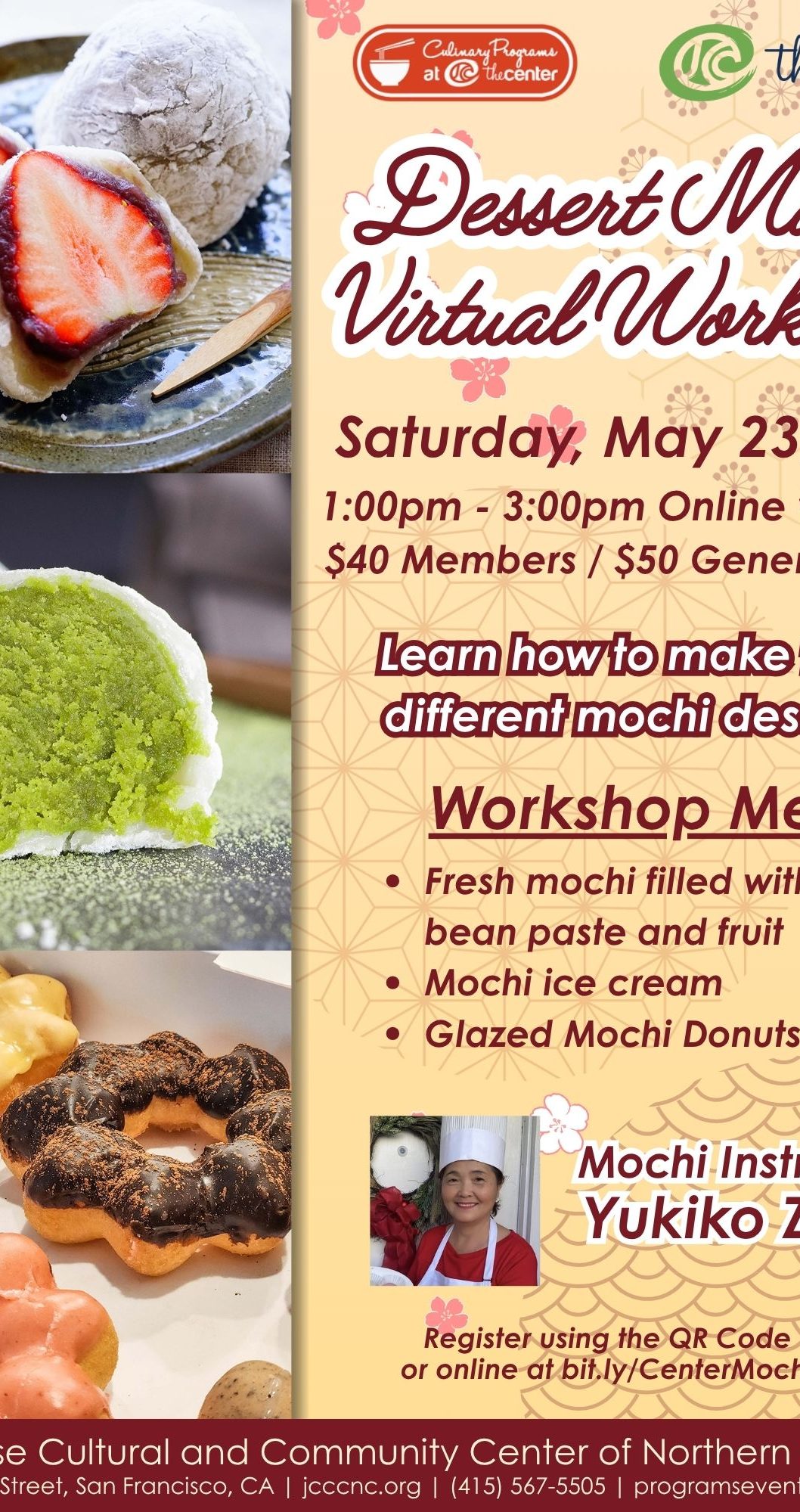
Virtual Dessert Mochi Workshop taught by Yukiko Zinke. Recorded by the Japanese Cultural and Community Center of Northern California on Saturday, May 23, 2026.
News
Virtual Dessert Mochi Workshop with Yukiko Zinke
May 26th, 2026The Community 120 Years Ago: The First Japanese Businesses of San Francisco
April 30th, 2026This April, we remember the great earthquake and fires of April 18, 1906.
The disaster destroyed major parts of San Francisco including the [current] South Park area where many early Japanese immigrants resided.
Unfortunately, very little firsthand information exists from this period of time about the life in the Japanese town areas (Nihonjin Machi) which has caused us to often forget about this chapter of San Francisco history.
This map uses directory data from the Japanese America History Archives (JAHA) to illustrate the number of businesses affected by the devastation. Maps created by Ben Pease.
The only physical memory of Japanese living in South Park is a small sign included in the neighborhood’s history. It reduces the stories of Japanese living there and their hardship, to a few lines.
The sign reads:

“Japanese immigrants operate hotels at 22-24, 102, 104 South Park St. Filipino merchant marines purchase 104-106 South Park St. and rename it the Gran Oriente Filipino Hotel”
“1942: The Morino brothers, Japanese owners of a hotel, located at 108 South Park St. where the South Park Cafe now stands, were interned during World War II.”


Pictures taken by JAHA staff.
We encourage you to visit these sites, and take a moment to imagine what life was like for the Issei (first generation Japanese immigrants) who were establishing themselves in an unfamiliar, unforgiving, and unwelcome place.


Pictured (above): Omiya Inn and Store in South Park, San Francisco, circa 1920 (left). Hotel Bo-Chow established in 1913, 102 South Park Street. JAHA, Takahashi Issei Heritage Center.
South Park and SoMa
Map 1 — South Park (c. 1900–1910)

Omiya Hotel (108 South Park)
Eimoto Ryokan (130 South Park)
Hotel Bochow (102 South Park)
Omaya Shoten (102A South Park)
Kumamoto-Ya Hotel (70 South Park)
Tsuchida-Doko Barber Bathhouse (56 South Park)
Fukuoka-Ya Hotel (171 South Park)
Map 2 — South of Market (c. 1900)

6th Street corridor & surrounding blocks:
Tamura Ryokan Hotel; Tamura-ya Bath House; Shiseno-doko Barber; T. Honda Employment Agency; Baba Ryokan; Kuramoto-doko Barber; Kuramoto Pool Hall; Kamiya Bookstore; Hiroshima-ya Hotel; Ishikawa Benkyodo Confectionery
Mission Street (near 6th–7th):
Geishu-ya Hotel; Yokohama-doko Barber; Matsumoto Pool Hall; Suehiro-yu Bath House; Y. Miyoshi Dental Office; Sanyo-kan Hotel; Yanai-ya Hotel; Hotel Meigetsu; Japanese-run restaurant
Jessie Street / interior blocks:
Y. Suito Books & Magazine Rentals; Japanese Methodist Episcopal Mission; Young Men’s Buddhist Association (meeting hall)
Additional hotels:
Kohsa-ya Hotel (with steam laundry); Nikko-ro Hotel; Hinomaru-tei Hotel; Iki Shiranuhi Hotel
2026 Kase Program
April 3rd, 2026Are you a college student active in the JA community? Interested in a $5,000 scholarship and want to support cultural and community sustainability? Intern at the Center as a participant of the 11-week Kase Nikkei Community Scholarship Program.
Spring Kaiseki Virtual Cooking Workshop
March 30th, 2026Spring Kaiseki Virtual Cooking Workshop taught by Larry Sokyo Tiscornia and Kimika Soko Takechi. Recorded by the Japanese Cultural and Community Center of Northern California on Saturday, March 28, 2026.
The Community 120 Years Ago: Proposal of an Anti-Japanese Bill (排日案提議し)
March 23rd, 2026This Shin Sekai article captures the early and escalating anti-Japanese political wave across the United States. The anti-immigrant sentiment and legal frameworks proposed in 1907, such as Nevada’s land restrictions, served as a direct precursor that built the political momentum leading to California’s 1913 Alien Land Law. This law prohibited “aliens ineligible for citizenship” from owning agricultural land and restricted leases to no more than three years. The newspaper further mentions that anti-Japanese sentiment extended far beyond land ownership, to also include education, freedom of movement and citizenship rights.

Caption Translation:
“Revocation of Naturalization Rights” (帰化権取上げ) indicates a political and legal push to strip or outright deny citizenship and naturalization rights to Japanese immigrants.
“Restriction on Destination” (行先地の制限) describes policies designed to strictly control the movement of Japanese individuals, specifically efforts to prevent immigrants holding passports for Hawaii, Mexico, or Canada from using them to enter the U.S. mainland.
There was also the active formation and spread of dedicated anti-Japanese organizations, with one headline announcing that an anti-Japanese society (排日會), similar to those operating in California, had just been established.
At the time this article was published, Japanese agricultural landholdings totaled 131,292 acres. 13,815 were owned, 56,889 cash-leased, 48,228 share-leased, and 13,359 under contract (Ichioka, 1988). When the Alien Land Law was enacted in 1913, Japanese individuals, companies with majority Japanese ownership, and Japanese landholders were prohibited from selling to or purchasing land from other immigrants. The law was further tightened in the 1920s to close loopholes, including the practice of transferring land to American-born children.
Articles like these illustrate how legal restrictions systematically prevented Japanese immigrants from advancing economically. Despite operating less than 2% of agricultural land, they were met with disproportionate legal barriers and political hostility whilst growing over ⅓ of the state’s produce (Lin & Peri, 2023). This shows not only the depth of exclusionary policy but also how much Japanese were perceived as a threat, revealing a broader pattern of racialized fear further shaping U.S. law and society. The prewar period was one of constant struggle, but Japanese immigrants still found a way to persevere.
(1907, March 13). Page 1. 新世界 = The New World. https://hojishinbun.hoover.org/en/newspapers/tnw19070313-01.1.1
Lin, Peter Zhixian, and Giovanni Peri. How the 1942 Japanese Exclusion Impacted US Agriculture. NBER Working Paper No. 33971
Ichioka, Y. (1988). The Issei: The world of the first generation Japanese immigrants, 1885–1924. Free Press.
Shin Sekai Collection, Japanese American History Archives
Spring Wagashi Sweets Virtual Cooking Workshop
March 4th, 2026Spring Wagashi Sweets Virtual Cooking Workshop taught by Larry Sokyo Tiscornia and Kimika Soko Takechi. Recorded by the Japanese Cultural and Community Center of Northern California on Saturday, February 28, 2026.
Join our Team!
February 26th, 2026The Center is seeking creative, committed, and imaginative members for our Programs Department. They will be responsible for developing and expanding community programs and activities that promote and enhance our Japanese and Japanese American cultural heritage. We are hiring for a Director of Programs. Learn more here
The Community 120 Years Ago: More Than Just A Bank
February 26th, 2026Did you know that 120 years ago the Japanese American community in San Francisco was an economic powerhouse despite facing severe discrimination? Here, we look at two advertisements from the Shin Sekai Newspaper (新世界, The New World), to give us a glimpse of how much power that was.
Our records reveal that the Imperial Bank (Teikoku Gakuin), located at 1543 Laguna Street between Post and Sutter, where Geary Street now runs, had an advertised capital of $100,000-equivalent to approximately $3.5 million today. In comparison, the Bank of Italy (founded in 1904 and known today as Bank of America) began with a starting capital of around $150,000.
On an even larger scale, The Yokohama Specie Bank (YSB) was a major pre-World War II Japanese foreign exchange bank with a wide international branch network, serving in Asia, Europe, and the United States. YSB had an authorized capital of 24,000,000 yen equating to approximately $12 million USD at contemporary exchange rates in the 1880s, roughly 120 times larger than either the Imperial Bank or the Bank of Italy. It offered fixed-term interest rates of 4–5%. At a 5% rate, $12 million would generate $600,000 in annual interest alone, six times the entire starting capital of the Imperial Bank. In 1907, $12 million represented the scale of a major international financial institution. At the time, one U.S. dollar was roughly equivalent to two Japanese yen, underscoring the significant value of a single dollar during that era.
The Imperial Bank and YSB handled foreign exchange and remittances, ensuring that capital earned by Japanese laborers in the United States could be securely transferred back to Japan. JAHA’s YSB collection has over 1,500 remittances, about 720 of which were sent from California. The total amount sent from California was $25,177.37, equal to around $488,000 today.
From just two advertisements in the Shin Sekai, we see a glimpse into the vitality of the Japanese economy and community. If this much success were possible under exclusion and hostility, one cannot help but wonder, how powerful might the Japanese community-and Japantown itself, have become had Executive Order 9066 never been enacted?

Advertisement Translation: The Imperial Bank (帝國銀行 – Teikoku Ginkō)
Located at 1543 Laguna Street, San Francisco, CA. Phone: West 2199.
The bank has opened for business at the address listed (between Geary and Post Streets) and will reliably handle general banking services. Customers are welcome to conduct transactions of any amount.
Capital: 100,000 Dollars.
Services and Annual Interest Rates: Fixed-term deposits: 6%; special checking accounts: 4%; Small savings (passbook) accounts: 4%.
Other services: Loans; remittances (money transfers) to Japan; and the buying and selling of public bonds and securities.
Leadership: President Shojiro Matsumura; Vice President Kikujiro Hayashi; Director: Kisaburo Aoki; Auditor Torakichi Iwai; Manager Chitosuke Matsuura; Consultant Masanosuke Miyamoto.

Advertisement Translation: The Yokohama Specie Bank Ltd. (横濱正金銀行 – Yokohama Shōkin Ginkō)
Located at 515 Montgomery Street, San Francisco, CA. Phone: Temporary 1396.
The head office is in Yokohama and was established in 1880 (Meiji 13). The bank lists branches and agencies in major cities including Tokyo, Osaka, London, Lyon, New York, Honolulu, Bombay, Hong Kong, and Shanghai, among others.
Capital: 24,000,000 Yen; Reserve Fund: 13,900,000 Yen.
Business Hours: Weekdays: 9:00 AM to 3:00 PM; Saturdays: 9:00 AM to 12:00 PM.
Deposit Interest Rates:
Head Office Fixed Deposits (500 Yen+): 5% for terms of 6 months or longer.
Head Office Current Deposits (50 Yen+): 4%.
San Francisco Branch Fixed Deposits ($25+): 4% for one year; 3% for six months.
(1907, February 20). Page 1. 新世界 = The New World. https://hojishinbun.hoover.org/en/newspapers/tnw19070220-01.1.1
(1907, February 20). Page 5. 新世界 = The New World. https://hojishinbun.hoover.org/en/newspapers/tnw19070220-01.1.5
YSB Collection, Japanese American History Archives
Shin Sekai Collection, Japanese American History Archives
The Community 120 Years Ago: From SOMA to the Western Addition
February 4th, 2026The 1906 earthquake and fires devastated the Japanese community in South of Market (SOMA), forcing displacement amid intense racial discrimination. Yet from this destruction came renewal. Japanese residents resettled in the Western Addition, laying the foundation for the Japantown that has endured for 120 years.
Japanese newspapers were vital lifelines for the community. Publications like Shin Sekai and Hokubei Mainichi documented community life when leaders and politicians ignored non-white communities. Though many issues of these publications were lost to the fires, during this time the surviving editions are our only link to early Japanese immigrant life before our current SF Japantown.

Here, we see Shin Sekai’s May 1906 issue listing an Oakland address, illustrating the quick reestablishment of the press despite devastation. The Japanese community was largely excluded from official city records and English-language coverage.
A temporary “San Francisco Japanese Relief Office” and business locations were listed in this May 1906 issue to help residents manage finances during the crisis. Coverage extended to the urgent needs of the community, focusing on food supplies and shelter arrangements following the destruction of residential areas. The paper also directed readers to the “Temporary Office of the Japanese Association” located in Oakland to assist those displaced. An image of Emperor Meiji was used as a symbol of unity and stability for Japanese immigrants.
Credits:
- Japanese American History Archives – Seizo Oka Collection. The Shin Sekai (May 1906-April 1912).
- 大震災雑観. “新世界 – The New World.” (San Francisco, CA), May 8, 1906. Accessed January 29, 2026.URL: https://hojishinbun.hoover.org/en/newspapers/tnw
- Hoji Shinbun, Hoover Institution, Stanford University.