The Community 120 Years Ago: Issei Women

October 9th, 2026

Official and unofficial records illustrate that the first group of Japanese women arrived in the United States between 1908–1920. They were often referred to as “picture brides,” but this generalized term does not accurately reflect what this first generation of women endured.

Through examining articles from the Hawaii Hochi, Shin Sekai, and oral histories housed at JAHA, we are able to get a better understanding and respect for what these women were forced to, in many cases, tragically experience from the moment they boarded the ship bound for the United States. It was not an uncommon practice in Japanese culture for a family to ask a friend or family member to introduce their son or daughter to a prospective marriage partner, and there are still instances where this happens today. This tradition is often referred to as miai.

However, for Japanese men residing in the United States in the early 20th century, it was not easy for a formal prospective marriage arrangement to take place because of the cost and distance between the two countries, and thus a substituted system of relying exclusively on a photo was adopted to start a relationship. Thus, the euphemism “picture bride” evolved. This label also characterizes early immigrant Issei women by a single moment and a photograph, suggesting that they were passive participants in their own lives. Some women came to the US to make their families happy; some chose to emigrate for their own reasons based on potential economic opportunity or family circumstances; and some arrived with the hope of a new beginning. Once here, they worked on farms, ran businesses and households, raised the Nisei generation, and helped build the Japanese American community.

In short, they were not “only brides”: they were Issei women whose lives extended far beyond the day they stepped off the ship. Thus, JAHA prefers the language use of “photo marriage” or simply “Issei women.”


From the Newspaper Archives

Shin Sekai: “Refusal of Landing for Photo-Married Women Is a False Rumor”

Rough translation

This article reports that the US Secretary of Commerce and Labor instructed immigration authorities to reject Japanese wives entering through photo marriages on the grounds that they were likely to become “public charges.” The report alleges that as many as 90 percent of arriving Asian women faced deportation. After the newspaper made a direct inquiry with the Immigration Bureau, the officials dismissed these claims as groundless. They confirmed that no such directive existed, and that any individual deportations had been carried out under general immigration laws that applied to all nationalities, not because the women were Japanese.

Immigration authorities further clarified that Japanese men and women were admitted on the same terms as nationals of most-favored nations, and that no special legal restrictions or additional burdens applied to photo marriages. The paper emphasized that exaggerated claims of targeted mistreatment had caused unnecessary alarm.

Accompanying commentary defended photo marriages as legitimate legal unions. It condemned malicious falsehoods directed at Japanese women, called for fair and equal treatment free from racial prejudice, and urged the Japanese immigrant community to remain united and composed.

However, anti-Japanese politicians and newspapers of the era used this opportunity to portray the practice of marrying individuals through a photograph as immoral or as a way around immigration limits, and that pressure led Japan to stop issuing passports to photo-marriage brides in 1920.


From the Oral History Collection

JAHA Oral History Reveals Personal Story of an Issei Mother’s Experience

A firsthand oral history reveals the serious personal dangers many Issei women faced upon arrival.

Upon docking in San Francisco, many Issei women did not know where to go or what their husbands actually looked like. In instances where husbands arrived late to the pier, or never came at all, stranded or unaccompanied women were often targeted by men who seemed kind and trustworthy. Promising to find their missing husbands or take them to where their husbands lived, these men lured vulnerable women into prostitution and trafficking. A woman’s life could change in an instant: some were forced into prostitution, while others were saved by people working near the docks who warned them not to go with these men. It was an early lesson that in this new country, they could not trust just anyone.

Here is an excerpt from the oral history in the JAHA files:

“I think my mother came in 1898, she was, I think, 15 years old. My father knew her. They lived about 4–5 miles apart in Usu. – She came third class. She was accompanied as far as Yokohama by my uncle. Once she got on board, she was on her own. There was a nice man that befriended her. She had cleared the immigration, and she had her papers, and my father was supposed to meet her, but he wasn’t there, and the young man told her he’d take her home and take her to her husband. She heard a voice behind her speaking in Japanese telling her to wait until her husband comes. And it was an immigration man. He knew the man by reputation, and he was taking girls into prostitution. She took the advice. —”

— AGR_PER_19881027_0001, JAHA Collection, Interview Transcript
The Community 120 Years Ago: Transforming Prefectural Ties into Pan-Japanese American Solidarity

September 29th, 2026

An Analysis of Early Issei Settlement from the 新世界 (Shin Sekai) • September 2, 1906

The September 2, 1906, edition on pages 3-4 of the 新世界 (Shin Sekai), details the daily labor, wages, and social practices of the Issei.

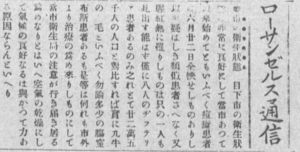
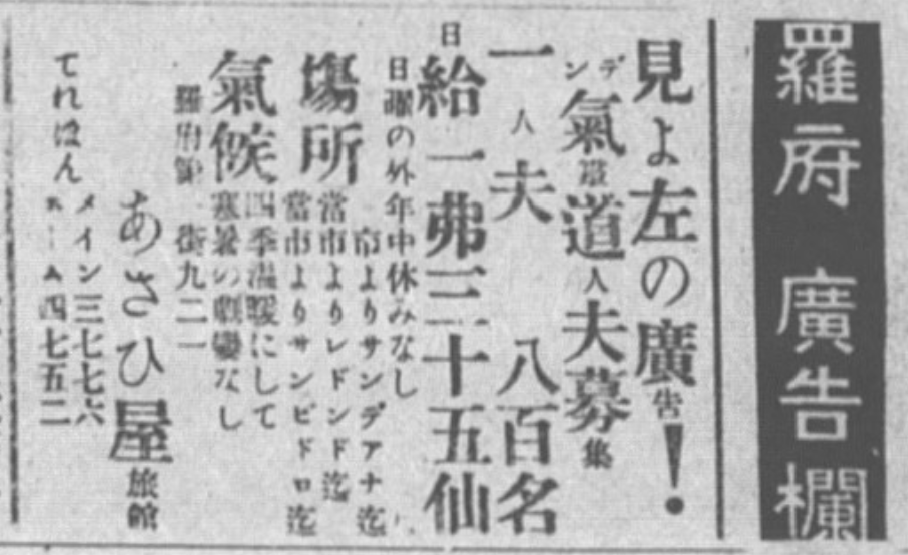
The article entitled Dispatches from Los Angeles [ローサンセルス通信”] provides a direct look into the economic reality of Japanese workers in Southern California. The article indicates that the summer fever among Issei in LA, caused many of them to fall ill daily. Due to the high demand for agricultural and physical labor, Issei workers faced a heightened vulnerability to heat exhaustion and sickness in addition to the poor sanitary conditions they suffered. Issei manual laborers earned a daily wage of “$1.35” per day, today’s equivalent to about $50.09 a day in 2026.

Business advertisements

In addition to the wage figures, the article describes how laborers managed daily routines during the summer heat, arranged temporary room and board, and navigated employment opportunities across agricultural and municipal work sites. The article also included tips on how to avoid falling ill and taking care of oneself.

In addition to describing the condition of workers, the article also serves as a survival directory for immigrant workers. Shin Sekai also allowed for ads by Labor recruitment agencies to place job services listed under headings like “勞働口周旋” (Labor Placement Agencies) in addition to featuring advertisements for Japanese run boarding houses and hotels like the Toyo Hotel, Fukui Inn as well as listings of neighborhood support. Outside of prefectural associations (kenjinkai) that supported Japanese immigrants adjusting to new life in the states, institutions like the Shin Sekai and Yokohama Specie Bank often added support to the guidance of new incoming Japanese immigrants.

As more newcomers arrived, the mutually supportive network made economic partnerships stronger between businesses and new Issei outside of prefectural circles, creating a self-reliant economic community, as well as help to those who did not have deep prefectural ties. Newspapers like Shin Sekai had a statewide circulation and helped spread information throughout the whole community, allowing a larger circle of Issei to identity as an ethnic group rather than just by prefectural ties.

Another article in this edition encourages readers to put aside private animosities and regionalism to build a social trust that can extend throughout the entire community “交際的關係の利害” (The Advantages and Disadvantage of Social Intercourse). This was emphasized by noting a story of a legal battle that illustrated harm to the collective reputation and financial standing of Japanese immigrants in America.

Los Angeles Dispatch excerpt

While Kenjinkais remained a valued social club/group, the daily struggle and necessity to find work, housing, and services, as well as interminority tensions, moved isolated prefectural groups and intra-ethnic rivalry into the more unified “pan-Japanese American” Nikkei identifying community that we see today.

Sources & Primary Documents

Main Source
新世界 (Shin Sekai / Japanese Daily New World), September 2, 1906, Issue No. 3962
Labor Conditions & Wage Data
Page 3: Dispatches from Los Angeles [ローサンセルス通信] tnw_19060902_0003.pdf
Community Services & Business Advertisements
Page 4, Column 1: Labor Placement Agencies, Toyo Hotel, Fukui Inn
tnw_19060902_0004.pdf
Financial Institutions
Page 1: The Yokohama Specie Bank, Ltd., San Francisco Branch
tnw_19060902_0001.pdf
Social Commentary & Community Identity
Page 3: The Advantages and Disadvantages of Social Intercourse [交際的関係の利害] tnw_19060902_0003.pdf


The Community 120 Years Ago: A Comparative Analysis of 1918 Departure Permits, Travel Restrictions, and 20-21st Century Modern Biometrics

September 3rd, 2026

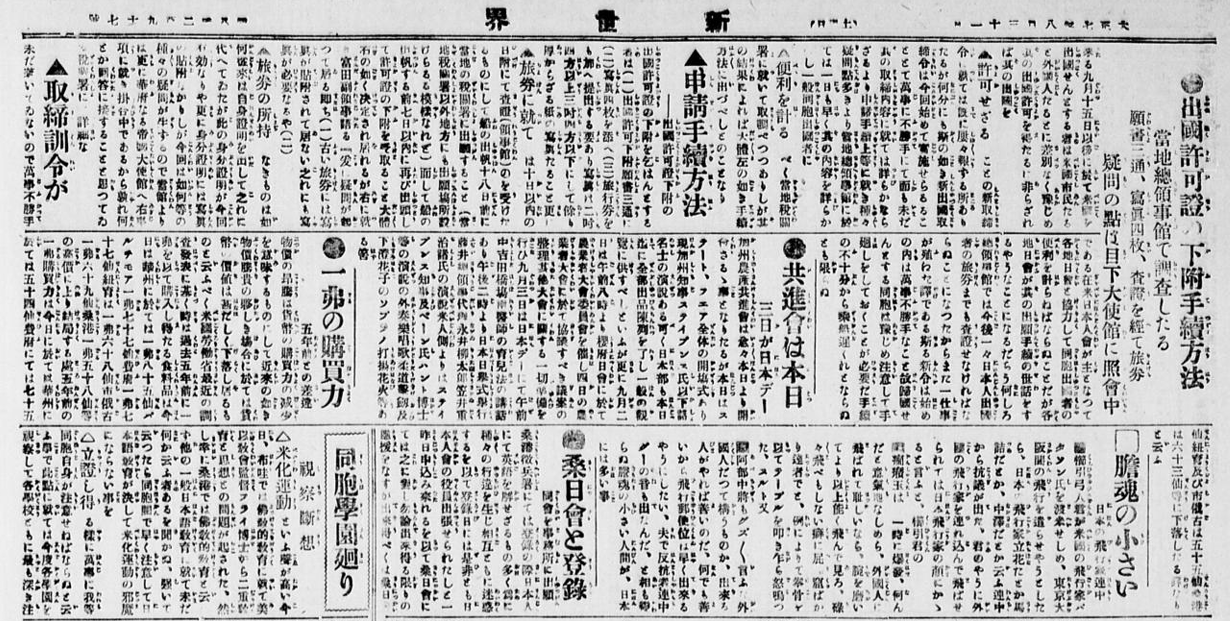
From the Shin Sekai in August 1918.08.31. Page 2.

As World War I neared its climax, the United States Government enacted strict wartime emergency measures designed to monitor and control all individuals departing from its shores. Among these regulations was a mandate requiring all travelers, including Japanese immigrants preparing to return to Japan, to obtain an official Departure Permit (Shukkoku Kyoka) before they would be allowed to board any departing vessel.

Because this federal order was rolled out rapidly under wartime pressure, points of embarkation and foreign consulates were left with little guidance.

To initiate the process, travelers had to compile and submit three identical copies of their departure application alongside their official passport.

Identification was entirely physical. Applicants were required to provide four physical photographs, which had to be precisely sized under four inches square. Most importantly, the protocol required one photo to be physically glued directly onto the passport, while the remaining three photos had to be pasted onto separate sheets of plain, unadorned paper.

Before submitting the application package to U.S. authorities, the applicant’s passport had to carry a consular visa that was dated within ten days of the submission.

The completed dossier had to be physically hand-delivered to the local US Customs Office (Zeikansho) at least 48 hours prior to the vessel’s scheduled departure. To finalize the process, travelers had to return to the Customs office within seven days of sailing to officially receive the physical departure permit.

The sudden administrative hurdle created widespread gridlock because many older passports lacked photographs, and since other travelers possessed only temporary “Certificates of Identity” (Mibun Shoumei), local Customs Officials were inconsistent in how they processed applications. The Japanese Consulate in San Francisco was forced to engage in long-distance communications with the Embassy in Washington, D.C., to resolve these operational ambiguities.

To prevent hundreds of travelers from missing their ships, the Japanese Association of America (So-Nichi Kai) stepped forward as an intermediary, dedicating resources to translate English-language customs forms, organize photo-taking drives, and guide non-English-speaking Japanese through customs procedures.

Today, technological innovation has transformed how the United States and global authorities manage international departures, shifting the administrative burden from local customs clerks to automated networks.

The physical photos and liquid glue of 1918 have been replaced by the Biometric Passport (e-Passport). Modern travel documents feature embedded contactless smart card RFID chips that contain digitized biographical information, a highly standardized digital photograph, and biometric identifiers (such as iris scans or fingerprints). At modern border checkpoints, automated facial recognition gates compare the traveler’s live face with the digital image stored in the passport chip, eliminating the manual photo-matching errors of the past.

Despite these digital advances, modern travel is not immune to wartime disruptions. The chaotic border closures, sudden quarantine mandates, and rapidly changing electronic health certificate requirements during the COVID-19 pandemic mirrored the confusion from August 1918. Similarly, sudden geopolitical conflicts or executive travel bans can instantaneously shut down electronic travel authorizations (like ESTA) or suspend visas, stranding passengers at airport boarding gates in a digital-era equivalent of the 1918 port-of-exit bottlenecks.

The most striking parallel between 1918 and the 21st century lies not in the state’s bureaucracy, but in the community’s response to it. When states implement restrictive or confusing security protocols, communities such as the Japanese American community have historically relied on grassroots advocacy to maintain their mobility and protect their legal rights.

1918 Advocacy (Analog)
Japanese Association (So-Nichi Kai)
2020 Advocacy (Digital)
Civil Rights & Immigrant Advocacy Non-Profits
Translated English Forms Multilingual Know-Your-Rights
Organized photo-taking Real Time Policy Tracking
Guided through customs office Legal aid at airports
Liaison with Consulate Emergency injunction litigation

In 1918, the So-Nichi Kai acted as a shield, protecting Japanese immigrants from falling out of legal status due to a simple misunderstanding of photo-mounting rules or English visa forms. In the 21st century, this exact role is filled by organizations like the American Civil Liberties Union (ACLU), the National Immigration Law Center (NILC), Asian Pacific Islander Legal Outreach (APILO) and various diaspora-specific legal aid clinics. When sudden travel bans or policy shifts are announced today, these groups mobilize immediately. They deploy lawyers to international arrival halls, publish real-time multilingual “Know Your Rights” toolkits on social media, shifting federal regulations, and file emergency injunctions in federal courts.

Term Reading Meaning
出国許可 Shukkoku Kyoka Departure Permit / Exit Permit.
身分証明 Mibun Shoumei Certificate of Identity / Proof of Status.
申請手続 Shinsei Tetsuzuki Application Procedures.
桑日会 Sō-Nichi Kai The Japanese Association of America. (Specifically, the San Francisco branch, where “Sō” / 桑 is the historic Japanese abbreviation for San Francisco, derived from Sōkō / 桑港).
在留同胞 Zairyū Dōhō Resident Compatriots / Immigrant Peers.
二吋四方 Ni-Inchi Shihō Two Inches Square. (吋 is the historic kanji for “inch”). This is the exact photo measurement specified in the article, matching modern U.S. passport photo standards.

The Community 120 Years Ago: The Importance of the Joshi Seinen Kai (Young Women’s Association)

July 28th, 2026

Following the 1907 Gentlemen’s Agreement which barred further entry of Japanese men to the United States, thousands of young Japanese women crossed the Pacific to the United States as “picture brides” [This term later became a demeaning way to label Issei women]. These women immigrated to this country to marry Japanese men through a pre-arranged marriage.  Many women only had a photograph or letter to rely on before meeting their husbands upon their arrival into this country. For many, the journey was a shocking introduction. The reality of their new lives clashed harshly with the promises they had been given; they found themselves in a strange, segregated country, wed to strangers that looked nothing like the pictures sent, and completely unprepared for the emotional and economic hardships of the quality of life they now faced.

To help these vulnerable women navigate their difficult new reality, a visionary group of Issei (first-generation) women, including Yona Abiko, a prominent member of the Japanese American society at that time, founded the San Francisco Joshi Seinen Kai (Young Women’s Association) in 1912. This association later became the Japanese YWCA as Japanese women were strictly barred from using the whites-only facilities including the San Francisco YWCA.  Thus, they had no choice but to build their own independent sanctuary which was designed by architect Julia Morgan.

The organization, (and later building), served as a vital lifeline for these women. It offered emergency and temporary housing for new arrivals, some who were abandoned shortly after their arrival, and provided essential skills such as learning English, understanding American customs, cooking, and sewing. Beyond survival, the Joshi Seinen Kai focused deeply on uplifting the inner lives, emotional well-being, and moral character of its members. This can be shown in many Shin Sekai articles published by Joshi Seinen Kai from America and Japan. Navigating an unexpected and often disappointing reality in a hostile country took a massive psychological toll. The association offered a vital space for women to process their feelings, work through their isolation, and lean on other supportive women.
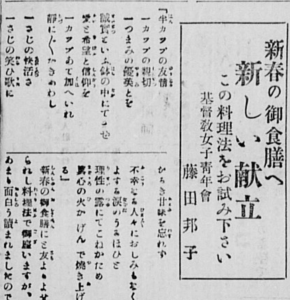
“A New Year’s Recipe”
Caption: “Page 2.” 新世界 = The New World, 1 Jan. 1930, hojishinbun.hoover.org/en/newspapers/tnw19300101-01.1.2. JAHA collection.
This focus on inner strength and character is captured in this Shin Sekai newspaper clipping featuring a metaphorical “New Year’s Recipe” submitted by club member Kuniko Fujita.
Roughly translated in English, “To the New Year’s Dining Table: A New Recipe,” the article bypasses actual food to offer a poetic guide for living a virtuous, resilient life.
  • Blend “half a cup of friendship” and “one cup of kindness.”
  • Add a pinch of grace, and put these together inside a “bowl called sincerity.”
  • Add one cup each of “love, hope, and faith,” and stir quietly.
  • Add a spoonful of cheerfulness and smiles, give generously to unfortunate people with sympathetic tears, knead the mixture with the dew of reason, and finally, bake it over the “heat of a sincere heart.”
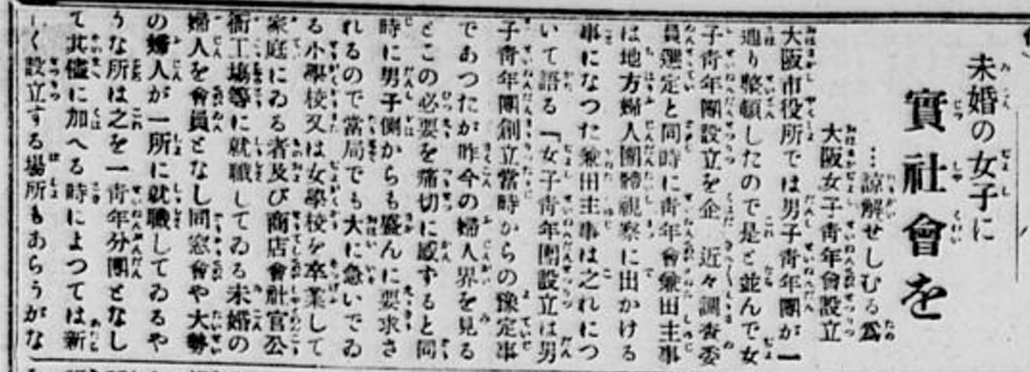
The mission to guide and support women through changing times was not limited to the United States. There were other branches in Japan, such as the Osaka Joshi Seinen Kai, which was established to help young women navigate their evolving roles in a modernizing world.
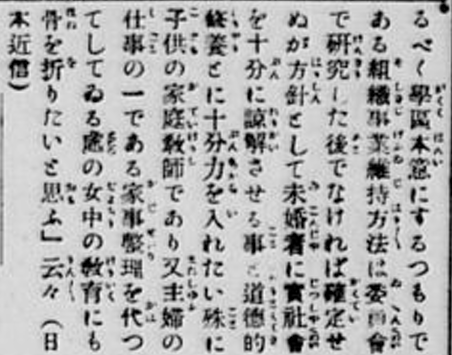
In another Shin Sekai newspaper clipping, the headline roughly translates to: “To help unmarried women understand real society / Osaka Women’s Youth Association Established.”
“Page 4.” 新世界 = The New World, 23 Sep. 1920, hojishinbun.hoover.org/en/newspapers/tnw19200923-01.1.4. JAHA collection.
The article explains that after the successful organization of a men’s youth group by the Osaka City Hall, strong demand necessitated a parallel women’s group.
This branch aimed to recruit unmarried women who had graduated from elementary or girls’ schools, including those working in shops, companies, factories, and government offices. Their central goal was to provide “moral cultivation” and help these women “fully understand real society.” The article also explicitly translates a desire to focus on the “education of maids,” noting that maids effectively acted as family tutors for children and took over the heavy responsibilities of household management.
Whether in San Francisco or Osaka, the Joshi Seinen Kai was much more than a social club. It was a critical emotional and cultural refuge that empowered women to endure the profound shocks of their changing lives.

120 Years Ago: A Dekasegi Shosei’s American Dream, Recovered from Shin Sekai (新世界 = The New World) history, and other documentation

July 6th, 2026

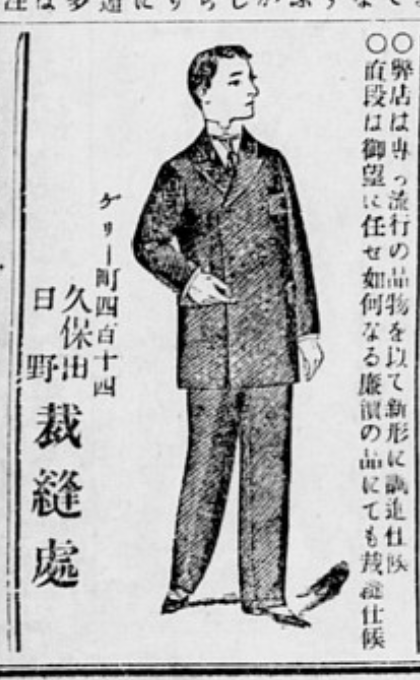
February 10, 1897. Ads from the Shin Sekai (The New World) reveal that Japanese immigrants were actively seeking Western clothing and abandoning traditional Japanese dress. 

June 26, 1897. A three-line notice appeared in the help-wanted columns of the San Francisco Chronicle:

“Japanese boy wishes a situation to do light housework: has good recommendation. Please address Masuko 1329 Pine St.”¹

Like the story of many other dekasegi, this boy was fifteen, and his address was the Japanese Methodist Episcopal Mission Church. His name was Takanori Mashiko, which was later shortened to Masuko, later Anglicized to Masko, and eventually he went by the nickname Tozan. He had reached San Francisco barely a year earlier, around the beginning of May 1896, after boarding the SS Doric at Yokohama around spring and crossing the Pacific alone. A prominent politician from his home district in Fukushima, Hironaka Kono, had urged him to study in the United States, master English, and prepare for the world power that Japan was about to become. ²

Masko belonged to a particular class of Issei: the privately funded working students, or dekasegi shosei. As Professor Yoshida has shown, according to Kumajirō Ishida’s 1886 emigration guidebook Kitare Nipponjin (Come, Japanese)-such students were typically young men of fifteen to twenty-five, from families of some means and education, who came to acquire English and a working knowledge of Western culture in order to raise their standing once they returned to Japan.³ Masko was a son of Kurobei Mashiko, a Fukushima landowner and entrepreneur who kept a house in Tokyo; as a boy he had frequented the offices of the Yamato newspaper and impressed its reporters with his precocity; and he had crossed the Pacific, at Kono’s urging, expressly to acquire English and a Western education. Like many students, he supported himself with part-time labor while he studied, with the domestic “schoolboy” work his Chronicle notice sought, and the wages he earned at the Shin Sekai.⁴

The paper he worked for was the Shin Sekai (新世界 = The New World), a Japanese-language daily founded in 1894 by Hachiro Soejima. When Tozan was there in 1897, it was only a small enterprise with a circulation of only about two hundred. Its surviving pages from that winter, were among the few issues we have to look into the daily life of early Japanese San Francisco.⁵ The teenager who placed the notice in the Chronicle was also one of the staff helping to produce those issues.

Almost none of the Shin Sekai issues from Masko’s years survived. The earthquake and fire of April 1906 destroyed the presses, offices, and back files of San Francisco’s Japanese immigrant press. The earliest issue of the paper that survives today dates only to August 28, 1895.⁶ We cannot read Masko’s byline, or find his name in a masthead, or recover a single sentence he wrote in those years. The record of his story survives not in the paper he worked for, but in information scattered across other documents referenced below.

Just from those fragments, we know that summer Masko left the mission for the household of the sugar magnate Claus Spreckels near Santa Cruz, where he cooked, attended an American high school, and learned baseball. He returned to the Shin Sekai in 1902, and Soejima placed him at the head of the paper’s Fresno bureau; when he left it under circumstances the record no longer explains, he carried his trade south to Los Angeles in 1904.⁷

In Los Angeles, Masko found the success he had crossed the ocean to pursue. Not in the newsroom, but on the ballfield. He was apparently never much of a player, but had a newspaperman’s flair for spectacle, and he turned it into a career as a baseball promoter, organizing by the end of the decade the first professional Japanese ball clubs owned and run by an immigrant on either side of the Pacific. ⁸ The dekasegi shosei who had once advertised for housework and headed a Shin Sekai branch, had made himself an issei baseball pioneer

Footnotes

  1. San Francisco Chronicle, June 26, 1897, help-wanted advertisement.
  2. Robert K. Fitts, Issei Baseball: The Story of the First Japanese American Ballplayers (Lincoln: University of Nebraska Press, 2020), ch. 4.
  3. Ryo Yoshida, The Japanese Immigrant Community in America during Its Formative Years as Seen in the Fukuinkai Enkaku Shiryō (The Gospel Society Historical Sources): Non-sectarian Strategies of Welfare and Educational Advocacy among Japanese Immigrants in Late Nineteenth-Century America, citing Kumajirō Ishida, Kitare Nipponjin (Come, Japanese) (1886).
  4. Kazuo Ito, Issei: A History of Japanese Immigrants in North America, trans. Shinichiro Nakamura and Jean S. Gerard (Seattle: Executive Committee for Publication of Issei / Japanese Community Service, 1973).
  5. Fitts, Issei Baseball, ch. 4; Shin Sekai (The New World), February 10, 1897, advertisements, Japanese American History Archives, Seizo Oka Collection.
  6. Fitts, Issei Baseball, ch. 4; Shin Sekai (The New World), August 28, 1895, Hoji Shinbun Digital Collection, Hoover Institution Library & Archives, Stanford University.
  7. Fitts, Issei Baseball, ch. 4.
  8. Fitts, Issei Baseball, chs. 7–10.

Bibliography

Image: “Page 2.” 新世界 = The New World, 24 Jan. 1929, hojishinbun.hoover.org/en/newspapers/tnw19290124-01.1.2.

Fitts, Robert K. Issei Baseball: The Story of the First Japanese American Ballplayers. Lincoln: University of Nebraska Press, 2020.

Ishida, Kumajirō. Kitare Nipponjin (Come, Japanese). 1886. Quoted in Yoshida, The Japanese Immigrant Community in America during Its Formative Years.

Ito, Kazuo. Issei: A History of Japanese Immigrants in North America. Translated by Shinichiro Nakamura and Jean S. Gerard. Seattle: Executive Committee for Publication of Issei / Japanese Community Service, 1973.

San Francisco Chronicle. Help-wanted advertisement. June 26, 1897.

Shin Sekai (The New World). August 28, 1895. Hoji Shinbun Digital Collection, Hoover Institution Library & Archives, Stanford University.

Shin Sekai (The New World). February 10, 1897. Advertisements. Japanese American History Archives, Seizo Oka Collection.

Yoshida, Ryo. The Japanese Immigrant Community in America during Its Formative Years as Seen in the Fukuinkai Enkaku Shiryō (The Gospel Society Historical Sources): Non-sectarian Strategies of Welfare and Educational Advocacy among Japanese Immigrants in Late Nineteenth-Century America.

The Community 120 Years Ago: Assimilation and Exoticism in the Japanese Culture Fad (1897)

June 10th, 2026

February 10, 1897. Ads from the Shin Sekai (The New World) reveal that Japanese immigrants were actively seeking Western clothing and abandoning traditional Japanese dress.

(Left): Advertisements for businesses such as Kubota Tailoring Place (久保田裁縫處) and Numata Tailoring Place (沼田裁縫處) emphasized the production of Western-style garments tailored specifically for Japanese customers, whose proportions differed from Euro-American counterparts. This advertisement for Kubota prominently features a Japanese man dressed in a formal Western suit.¹

For Issei immigrants, especially women, Western clothing was a social necessity tied to survival and acceptance. Picture brides arriving in the United States between 1907 and 1908 were commonly photographed in kimono upon arrival and then quickly taken to Western clothing shops for fittings. Many wedding portraits show Issei women in Western bridal gowns rather than traditional Japanese wedding attire. Oral histories frequently describe the emotional disorientation of abandoning familiar clothing traditions in favor of American fashion standards.²

As Issei women struggled to adapt to Western dress, white American society simultaneously romanticized and commodified Japanese clothing and femininity. The society that pressured Japanese immigrants to abandon visible markers of Japanese identity indulged in “Japanese luncheon” parties where upper San Franciscan white women dressed themselves in kimono, sandals, and haori as exotic entertainment. Japanese culture was considered fashionable and amusing when performed by white Americans, but undesirable or foreign when embodied by Japanese.³

Issei women often wore Western clothing that was already outdated by contemporary American standards—wearing Victorian-style dresses long after blazers and neckties had become fashionable. This reflects the conservative image of American dress that many immigrants observed before emigrating and how Japanese traditions remained deeply rooted among many immigrants, who chose more conservative and less flashy styles of dress. While white Americans freely experimented with “Japanese costume” for leisure, Japanese women themselves were navigating intense scrutiny over how “American” they appeared.⁴

The San Francisco Call described the trend enthusiastically:

“Japanese luncheons became intensely popular among society women weary of the monotony of English-style afternoon teas and matinee lunches.”⁵

At these gatherings, affluent white San Franciscans decorated themselves and their homes with “Oriental” objects, regardless of origin. Guests consumed dishes labeled “suimono,” “yakizakana,” and “sashimi” while surrounded by imported objects from Turkey, China, and Japan indiscriminately grouped together as “Eastern.” Parties even advertised the presence of servants “only from Japan” as part of the entertainment value.⁶

White women could temporarily wear kimono and imitate Japanese femininity without experiencing the discrimination faced by Japanese immigrants themselves. Meanwhile, Issei women were expected to abandon their own cultural appearance in order to appear civilized and assimilated within American society.

More than 120 years later, Japantown remains associated with Japanese pop culture, fashion, and entertainment. But unlike today’s celebration of Japanese aesthetics, the “Japanese fad” of the 1890s reflected a society fascinated with consuming Japanese culture while marginalizing Japanese immigrants themselves.

Footnotes

  1. Shin Sekai (The New World), February 10, 1897, advertisements for Kubota Tailoring Place (久保田裁縫處) and Numata Tailoring Place (沼田裁縫處).
  2. Amy Sueyoshi, “Mindful Masquerades: Que(e)Rying Japanese Immigrant Dress in Turn-of-the-Century San Francisco,” Frontiers: A Journal of Women Studies 26, no. 3 (2005): 67–100.
  3. Sueyoshi, “Mindful Masquerades,” 67–100.
  4. Sueyoshi, “Mindful Masquerades,” esp. discussion of Issei women’s adoption of conservative Western dress and immigrant clothing practices.
  5. “The Japanese Luncheon Fad,” San Francisco Call, February 14, 1897.
  6. San Francisco Call, February 14, 1897, “The Japanese Luncheon Fad”; see also Sueyoshi, “Mindful Masquerades,” for analysis of the social and racial meanings of these performances.

Bibliography

San Francisco Call. “The Japanese Luncheon Fad.” February 14, 1897.

Shin Sekai (The New World). February 10, 1897. Advertisements. Japanese American History Archives, Seizo Oka Collection.

Sueyoshi, Amy. “Mindful Masquerades: Que(e)Rying Japanese Immigrant Dress in Turn-of-the-Century San Francisco.” Frontiers: A Journal of Women Studies 26, no. 3 (2005): 67–100. http://www.jstor.org/stable/4137374.

The Community 120 Years Ago: The First Japanese Businesses of San Francisco

April 30th, 2026

This April, we remember the great earthquake and fires of April 18, 1906.

The disaster destroyed major parts of San Francisco including the [current] South Park area where many early Japanese immigrants resided.

Unfortunately, very little firsthand information exists from this period of time about the life in the Japanese town areas (Nihonjin Machi) which has caused us to often forget about this chapter of San Francisco history.

This map uses directory data from the Japanese America History Archives (JAHA) to illustrate the number of businesses affected by the devastation. Maps created by Ben Pease. 

The only physical memory of Japanese living in South Park is a small sign included in the neighborhood’s history. It reduces the stories of Japanese living there and their hardship, to a few lines. 

The sign reads:

“Japanese immigrants operate hotels at 22-24, 102, 104 South Park St. Filipino merchant marines purchase 104-106 South Park St. and rename it the Gran Oriente Filipino Hotel”

“1942: The Morino brothers, Japanese owners of a hotel, located at 108 South Park St. where the South Park Cafe now stands, were interned during World War II.”

Pictures taken by JAHA staff.

We encourage you to visit these sites, and take a moment to imagine what life was like for the Issei (first generation Japanese immigrants) who were establishing themselves in an unfamiliar, unforgiving, and unwelcome place. 


Pictured (above): Omiya Inn and Store in South Park, San Francisco, circa 1920 (left). Hotel Bo-Chow established in 1913, 102 South Park Street. JAHA, Takahashi Issei Heritage Center.

South Park and SoMa

Map 1 — South Park (c. 1900–1910)

Omiya Hotel (108 South Park)
Eimoto Ryokan (130 South Park)
Hotel Bochow (102 South Park)
Omaya Shoten (102A South Park)
Kumamoto-Ya Hotel (70 South Park)
Tsuchida-Doko Barber Bathhouse (56 South Park)
Fukuoka-Ya Hotel (171 South Park)


Map 2 — South of Market (c. 1900)

6th Street corridor & surrounding blocks:
Tamura Ryokan Hotel; Tamura-ya Bath House; Shiseno-doko Barber; T. Honda Employment Agency; Baba Ryokan; Kuramoto-doko Barber; Kuramoto Pool Hall; Kamiya Bookstore; Hiroshima-ya Hotel; Ishikawa Benkyodo Confectionery

Mission Street (near 6th–7th):
Geishu-ya Hotel; Yokohama-doko Barber; Matsumoto Pool Hall; Suehiro-yu Bath House; Y. Miyoshi Dental Office; Sanyo-kan Hotel; Yanai-ya Hotel; Hotel Meigetsu; Japanese-run restaurant

Jessie Street / interior blocks:
Y. Suito Books & Magazine Rentals; Japanese Methodist Episcopal Mission; Young Men’s Buddhist Association (meeting hall)

Additional hotels:
Kohsa-ya Hotel (with steam laundry); Nikko-ro Hotel; Hinomaru-tei Hotel; Iki Shiranuhi Hotel


The Community 120 Years Ago: Proposal of an Anti-Japanese Bill (排日案提議し)

March 23rd, 2026

This Shin Sekai article captures the early and escalating anti-Japanese political wave across the United States. The anti-immigrant sentiment and legal frameworks proposed in 1907, such as Nevada’s land restrictions, served as a direct precursor that built the political momentum leading to California’s 1913 Alien Land Law. This law prohibited “aliens ineligible for citizenship” from owning agricultural land and restricted leases to no more than three years. The newspaper further mentions that anti-Japanese sentiment extended far beyond land ownership, to also include education, freedom of movement and citizenship rights.

Caption Translation:

“Revocation of Naturalization Rights” (帰化権取上げ) indicates a political and legal push to strip or outright deny citizenship and naturalization rights to Japanese immigrants.

“Restriction on Destination” (行先地の制限) describes policies designed to strictly control the movement of Japanese individuals, specifically efforts to prevent immigrants holding passports for Hawaii, Mexico, or Canada from using them to enter the U.S. mainland.

There was also the active formation and spread of dedicated anti-Japanese organizations, with one headline announcing that an anti-Japanese society (排日會), similar to those operating in California, had just been established.

At the time this article was published, Japanese agricultural landholdings totaled 131,292 acres. 13,815 were owned, 56,889 cash-leased, 48,228 share-leased, and 13,359 under contract (Ichioka, 1988). When the Alien Land Law was enacted in 1913, Japanese individuals, companies with majority Japanese ownership, and Japanese landholders were prohibited from selling to or purchasing land from other immigrants. The law was further tightened in the 1920s to close loopholes, including the practice of transferring land to American-born children.

Articles like these illustrate how legal restrictions systematically prevented Japanese immigrants from advancing economically. Despite operating less than 2% of agricultural land, they were met with disproportionate legal barriers and political hostility whilst growing over ⅓ of the state’s produce (Lin & Peri, 2023). This shows not only the depth of exclusionary policy but also how much Japanese were perceived as a threat, revealing a broader pattern of racialized fear further shaping U.S. law and society. The prewar period was one of constant struggle, but Japanese immigrants still found a way to persevere.


(1907, March 13). Page 1. 新世界 = The New World. https://hojishinbun.hoover.org/en/newspapers/tnw19070313-01.1.1

Lin, Peter Zhixian, and Giovanni Peri. How the 1942 Japanese Exclusion Impacted US Agriculture. NBER Working Paper No. 33971

Ichioka, Y. (1988). The Issei: The world of the first generation Japanese immigrants, 1885–1924. Free Press.

Shin Sekai Collection, Japanese American History Archives

The Community 120 Years Ago: More Than Just A Bank

February 26th, 2026

Did you know that 120 years ago the Japanese American community in San Francisco was an economic powerhouse despite facing severe discrimination? Here, we look at two advertisements from the Shin Sekai Newspaper (新世界, The New World), to give us a glimpse of how much power that was.

Our records reveal that the Imperial Bank (Teikoku Gakuin), located at 1543 Laguna Street between Post and Sutter, where Geary Street now runs, had an advertised capital of $100,000-equivalent to approximately $3.5 million today. In comparison, the Bank of Italy (founded in 1904 and known today as Bank of America) began with a starting capital of around $150,000.

On an even larger scale, The Yokohama Specie Bank (YSB) was a major pre-World War II Japanese foreign exchange bank with a wide international branch network, serving in Asia, Europe, and the United States. YSB had an authorized capital of 24,000,000 yen equating to approximately $12 million USD at contemporary exchange rates in the 1880s, roughly 120 times larger than either the Imperial Bank or the Bank of Italy. It offered fixed-term interest rates of 4–5%. At a 5% rate, $12 million would generate $600,000 in annual interest alone, six times the entire starting capital of the Imperial Bank. In 1907, $12 million represented the scale of a major international financial institution. At the time, one U.S. dollar was roughly equivalent to two Japanese yen, underscoring the significant value of a single dollar during that era.

The Imperial Bank and YSB handled foreign exchange and remittances, ensuring that capital earned by Japanese laborers in the United States could be securely transferred back to Japan. JAHA’s YSB collection has over 1,500 remittances, about 720 of which were sent from California. The total amount sent from California was $25,177.37, equal to around $488,000 today. 

From just two advertisements in the Shin Sekai, we see a glimpse into the vitality of the Japanese economy and community. If this much success were possible under exclusion and hostility, one cannot help but wonder, how powerful might the Japanese community-and Japantown itself, have become had Executive Order 9066 never been enacted?

Advertisement Translation: The Imperial Bank (帝國銀行 – Teikoku Ginkō)

Located at 1543 Laguna Street, San Francisco, CA. Phone: West 2199.

The bank has opened for business at the address listed (between Geary and Post Streets) and will reliably handle general banking services. Customers are welcome to conduct transactions of any amount.

Capital: 100,000 Dollars.

Services and Annual Interest Rates: Fixed-term deposits: 6%; special checking accounts: 4%; Small savings (passbook) accounts: 4%.

Other services: Loans; remittances (money transfers) to Japan; and the buying and selling of public bonds and securities.

Leadership: President Shojiro Matsumura; Vice President Kikujiro Hayashi; Director: Kisaburo Aoki; Auditor Torakichi Iwai; Manager Chitosuke Matsuura; Consultant  Masanosuke Miyamoto.

Advertisement Translation: The Yokohama Specie Bank Ltd. (横濱正金銀行 – Yokohama Shōkin Ginkō)

Located at 515 Montgomery Street, San Francisco, CA. Phone: Temporary 1396.

The head office is in Yokohama and was established in 1880 (Meiji 13). The bank lists branches and agencies in major cities including Tokyo, Osaka, London, Lyon, New York, Honolulu, Bombay, Hong Kong, and Shanghai, among others.

Capital: 24,000,000 Yen; Reserve Fund: 13,900,000 Yen.

Business Hours: Weekdays: 9:00 AM to 3:00 PM; Saturdays: 9:00 AM to 12:00 PM.

Deposit Interest Rates:

Head Office Fixed Deposits (500 Yen+): 5% for terms of 6 months or longer.

Head Office Current Deposits (50 Yen+): 4%.

San Francisco Branch Fixed Deposits ($25+): 4% for one year; 3% for six months.


(1907, February 20). Page 1. 新世界 = The New World. https://hojishinbun.hoover.org/en/newspapers/tnw19070220-01.1.1

(1907, February 20). Page 5. 新世界 = The New World. https://hojishinbun.hoover.org/en/newspapers/tnw19070220-01.1.5

YSB Collection, Japanese American History Archives

Shin Sekai Collection, Japanese American History Archives

The Community 120 Years Ago: From SOMA to the Western Addition

February 4th, 2026

The 1906 earthquake and fires devastated the Japanese community in South of Market (SOMA), forcing displacement amid intense racial discrimination. Yet from this destruction came renewal. Japanese residents resettled in the Western Addition, laying the foundation for the Japantown that has endured for 120 years.

Japanese newspapers were vital lifelines for the community. Publications like Shin Sekai and Hokubei Mainichi documented community life when leaders and politicians ignored non-white communities. Though many issues of these publications were lost to the fires, during this time the surviving editions are our only link to early Japanese immigrant life before our current SF Japantown.

Here, we see Shin Sekai’s May 1906 issue listing an Oakland address, illustrating the quick reestablishment of the press despite devastation. The Japanese community was largely excluded from official city records and English-language coverage.

A temporary “San Francisco Japanese Relief Office” and business locations were listed in this May 1906 issue to help residents manage finances during the crisis. Coverage extended to the urgent needs of the community, focusing on food supplies and shelter arrangements following the destruction of residential areas. The paper also directed readers to the “Temporary Office of the Japanese Association” located in Oakland to assist those displaced. An image of Emperor Meiji was used as a symbol of unity and stability for Japanese immigrants.

Credits:

  • Japanese American History Archives – Seizo Oka Collection. The Shin Sekai (May 1906-April 1912).
  • 大震災雑観. “新世界 – The New World.” (San Francisco, CA), May 8, 1906. Accessed January 29, 2026.URL: https://hojishinbun.hoover.org/en/newspapers/tnw
  • Hoji Shinbun, Hoover Institution, Stanford University.